
The Cost of Reactive Maintenance
Every maintenance manager knows the drill: a critical machine goes down unexpectedly, production stops, everyone scrambles, and the real cost isn’t just the repair — it’s the lost production, overtime labor, missed deliveries, and expedited spare parts.
Industry data puts the true cost of unplanned downtime at $50–$250 per minute for mid-size manufacturers. For a plant running 16–20 hours daily, even a 2% improvement in uptime translates to significant annual savings.
The Maintenance Maturity Ladder
Most plants sit somewhere on this spectrum:
- Reactive (Run-to-failure): Fix it when it breaks. The most expensive approach.
- Preventive (Calendar-based): Replace parts on a schedule. Better, but you’re often replacing parts too early (waste) or too late (failure).
- Condition-based: Monitor key parameters and act when they exceed thresholds. A significant step up.
- Predictive (ML-driven): Use machine learning to predict failures days or weeks in advance. The gold standard.
You don’t need to jump straight to Level 4. The biggest ROI often comes from moving from Level 1 to Level 3.
The Data You Need
Predictive maintenance models are only as good as their input data. The most valuable signals:
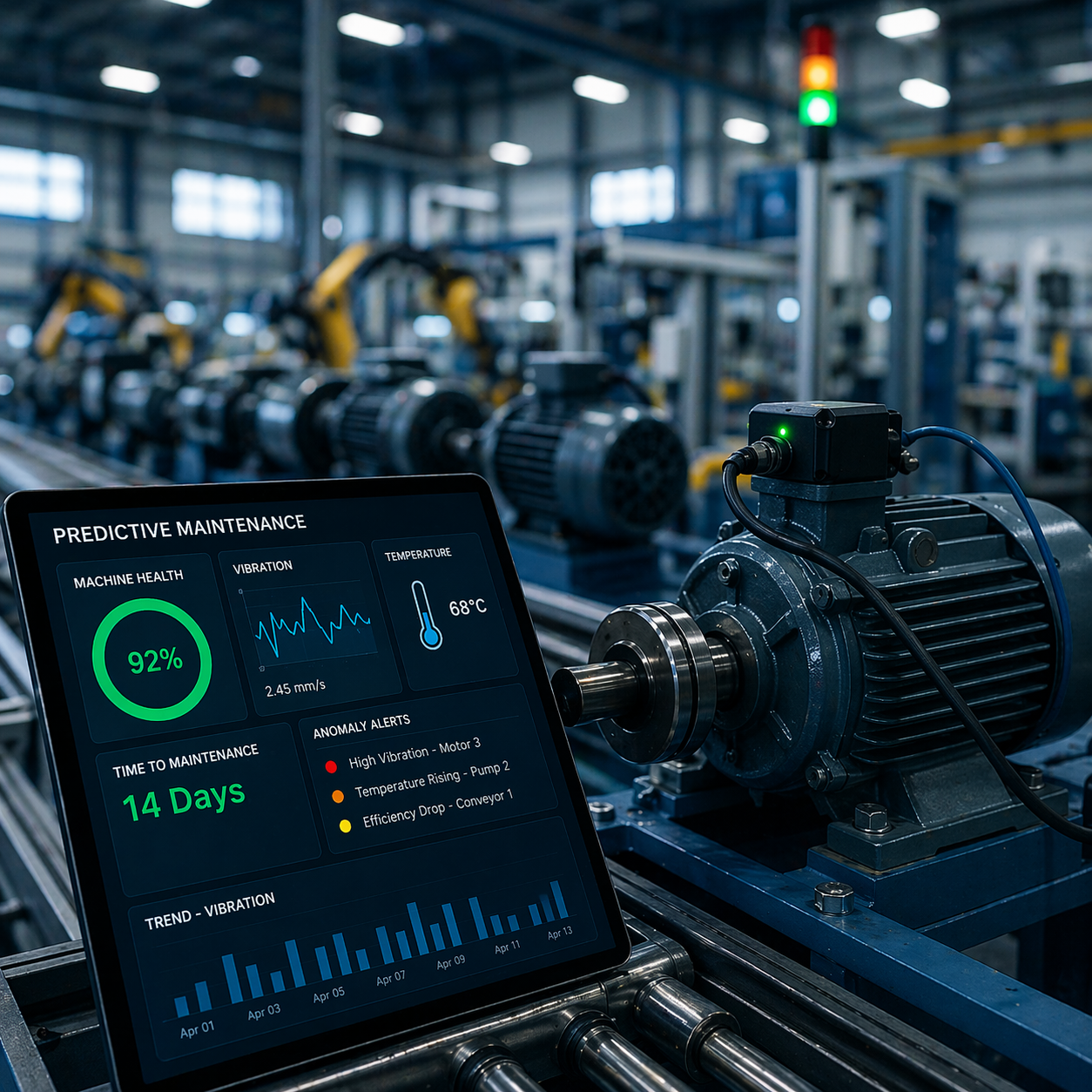
- Vibration: Accelerometers on rotating equipment detect bearing wear, imbalance, misalignment
- Temperature: Thermal sensors detect overheating in motors, drives, and bearings
- Current draw: Changes in motor current indicate mechanical stress
- Acoustic: Ultrasonic sensors detect air leaks, cavitation, and early-stage bearing failures
- Process parameters: Pressure, flow rate, cycle time deviations
Building vs. Buying
Off-the-shelf predictive maintenance platforms (AWS IoT, Azure Digital Twins, PTC ThingWorx) provide good infrastructure but require significant customization for your specific equipment. Custom solutions make sense when:
- You have specialized equipment with non-standard failure modes
- You need integration with existing CMMS/ERP systems
- Your data science team needs full control over model training and deployment
- Regulatory requirements demand on-premises data processing
Implementation Strategy
Start with your most critical and most problematic asset — the machine whose failure causes the most pain. Instrument it, collect 3–6 months of data (including at least one failure event), build your first model, and prove the value. Then scale the pattern.
The goal isn’t to predict every failure perfectly. It’s to give your maintenance team a 48–72 hour warning window so they can schedule repairs during planned downtime. Even a 60% prediction accuracy delivers massive value compared to pure reactive maintenance.
Interested in exploring predictive maintenance for your facility? Let’s talk about your equipment and data landscape.